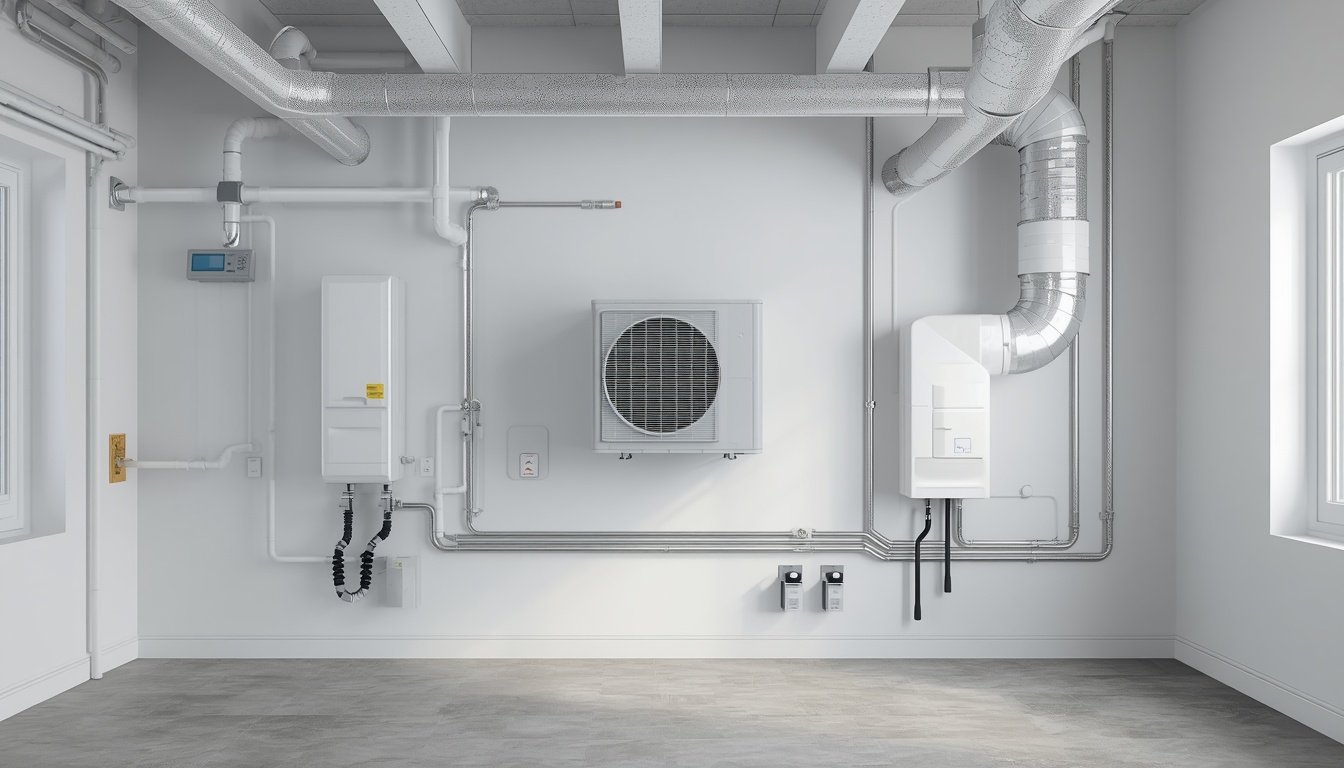
Whole-house ventilation is the process of bringing fresh outdoor air into a home while removing stale indoor air in a controlled way. It is different from simply opening windows or running bathroom fans because it is designed to manage air exchange across the home more deliberately. In tighter, better-sealed homes, ventilation becomes an important part of whole-home climate control because heating, cooling, humidity, and indoor air quality all depend on how air moves through the building.
A ventilation system can help reduce stale air, manage odors, support indoor air quality, and make the home feel fresher without relying only on random air leaks. The right setup depends on the home’s climate, insulation, air sealing, ductwork, humidity needs, and whether an ERV or HRV is the better match. If you are comparing product directions already, the article on the best whole-house ventilation system is a useful next step.
What This Guide Covers
This guide explains how home ventilation works, when it matters, and how to think about ERV and HRV systems as part of a larger climate control plan. It is designed for homeowners who are trying to understand stale indoor air, tightly sealed homes, humidity balance, fresh air exchange, and ventilation equipment before choosing a system.
The main point is that ventilation is not the same as filtration, heating, or cooling. A filter can help clean air that passes through the HVAC system, but it does not necessarily bring in fresh air. A dehumidifier can remove moisture, but it does not replace stale indoor air with outdoor air. A ventilation system focuses on controlled air exchange. That air exchange may also affect humidity, heating demand, cooling load, and overall comfort.
This is why whole-home ventilation should be considered alongside the rest of the house. A ventilation system that works well in one climate may not be the best fit in another. A system that makes sense for a tightly sealed new home may be unnecessary or poorly matched in a leaky older house. The article on whether every home needs mechanical ventilation explores that question more directly.
How Whole-House Ventilation Works
Whole-house ventilation works by creating a planned path for air to enter and leave the home. Instead of relying on cracks, gaps, open windows, or occasional exhaust fan use, a mechanical system moves air in a more predictable way. This can help reduce stale air and provide a more consistent fresh air strategy.
The two main system types in this cluster are ERVs and HRVs. An ERV is an energy recovery ventilator. It exchanges indoor and outdoor air while recovering some energy from the outgoing air stream, and it can also transfer some moisture depending on conditions and system design. An HRV is a heat recovery ventilator. It focuses on exchanging air while recovering heat, which can be especially relevant in colder climates. The comparison of ERV vs HRV explains the practical difference between the two.
These systems usually involve intake ducts, exhaust ducts, filters, a heat or energy exchange core, controls, and a fan system. Some installations connect to existing HVAC ductwork, while others use dedicated ducting. Either way, the system must be installed and balanced correctly so it brings in and exhausts the right amount of air without creating pressure problems.
Common Use Cases
One common use case is a tightly sealed home. Newer homes, renovated homes, and energy-upgraded homes may have less natural air leakage than older houses. That can be good for efficiency, but it may also mean stale air, odors, humidity, and indoor pollutants linger longer if there is no planned ventilation strategy.
Another use case is a home where windows stay closed for long periods. This can happen in very hot climates, cold climates, wildfire-prone areas, noisy neighborhoods, or homes where outdoor allergens and dust are a concern. In those situations, relying on open windows may not be practical or desirable. A whole-home ventilation system can provide fresh air in a more controlled way.
Ventilation is also relevant when humidity feels difficult to manage. An ERV may help support balanced fresh air exchange where moisture transfer is part of the decision, while an HRV may be more relevant where heat recovery is the priority. The article on whether ERVs help with humidity explains why ventilation and moisture control can overlap but are not the same thing.
Some homes also need ventilation because indoor air feels stale even when heating and cooling are working. In that case, upgrading the air conditioner or furnace may not solve the real issue. The home may need better air exchange, better filtration, or both.
Key Factors to Consider
- Home tightness, because a very leaky home and a tightly sealed home may need very different ventilation strategies.
- Climate, because cold, humid, dry, and mixed climates can point toward different ERV or HRV decisions.
- Ducting layout, because intake, exhaust, supply, and return paths need to be practical for the home’s structure.
- Humidity goals, because ventilation can affect moisture levels but should not be treated as a replacement for every humidity-control problem.
- Airflow balancing, because a poorly balanced system may create pressure issues, drafts, or uneven ventilation.
- Maintenance access, because filters, cores, drains, and service panels need to be reachable after installation.
- Total project cost, including the unit, ducting, controls, labor, balancing, and any changes needed to the HVAC system.
Choosing the Right Option
The right ventilation option starts with understanding why the home needs ventilation. If the issue is stale air in a tight home, an ERV or HRV may be worth considering. If the issue is dust, filtration may also be important. If the issue is high humidity, a dehumidifier may be needed in addition to ventilation. If the issue is dry winter air, a humidifier may be part of the broader solution.
Choosing between an ERV and an HRV is usually the biggest product-level decision. An ERV may be the better direction when moisture balance is part of the ventilation decision. An HRV may be the better direction when heat recovery is the main concern, especially in colder climates. The article on the best ERV for whole house and the article on the best HRV for cold climates cover those two paths separately.
Installation planning matters as much as the equipment choice. A ventilation unit must be placed where it can connect to ducts, reach suitable intake and exhaust locations, remain accessible for maintenance, and be balanced properly. For many homes, this is not a simple appliance purchase. The article on ERV and HRV installation requirements is useful before choosing a system.
Cost should also be judged as a complete project. The product price alone does not show the full cost of ducting, labor, controls, balancing, and possible HVAC integration. For budget planning, the ERV/HRV system cost breakdown gives a more realistic way to think about the investment.
Limitations and Considerations
Ventilation can improve air exchange, but it is not a cure for every indoor air problem. If the home has mold growth from water intrusion, ventilation alone will not fix the source. If dust is the main issue, filtration and housekeeping may matter more. If humidity is too high because of drainage or foundation problems, a ventilation system may not be enough by itself.
Outdoor air quality also matters. Bringing in outdoor air is not always automatically beneficial if the outdoor air is smoky, polluted, extremely humid, or full of allergens. In those situations, filtration, intake location, controls, and system operation become more important. A ventilation system should be planned around the real outdoor conditions where the home is located.
Maintenance is another limitation. ERV and HRV systems usually need filter changes, core cleaning, drain checks, and periodic inspection. If the system is ignored, airflow can drop and performance can suffer. The article on signs your ERV or HRV needs servicing explains what to watch for after installation.
The best result usually comes from treating ventilation as part of the whole-home system. Heating, cooling, humidity, filtration, air sealing, and ventilation all interact. A good ventilation plan should support comfort and air quality without creating new humidity, pressure, or energy problems.